- Home
- Blog
- Fasting Against Disease
- About Laing Z. Matthews
- Courses
- Publications
- Daoist Inner Alchemy
- Daoist Cosmology: Theory of Everything
- Thunder Magic
- Divination & Dream Interpretation
- Modern Awakening & OBE
- Sexual Cultivation
- Feng Shui
- Contact
- 鐵板神數譯讀 Tieban Shenshu in English
- 105 Esoteric Traditions of the World
- NAROPA’S SIX YOGAS: The Complete Training System (6 book series)
- Guided Inner Alchemy with Laing Z. Matthews
- The Healing Handbooks Simple Spiritual Remedies for Modern Disease (23 books)
- The Taoist Inner Alchemy Classics (19 books)
- Dream Interpretation
- Readers Testimonials
- Laing Z. Matthews Blog
- Audible Laing Z. Matthews
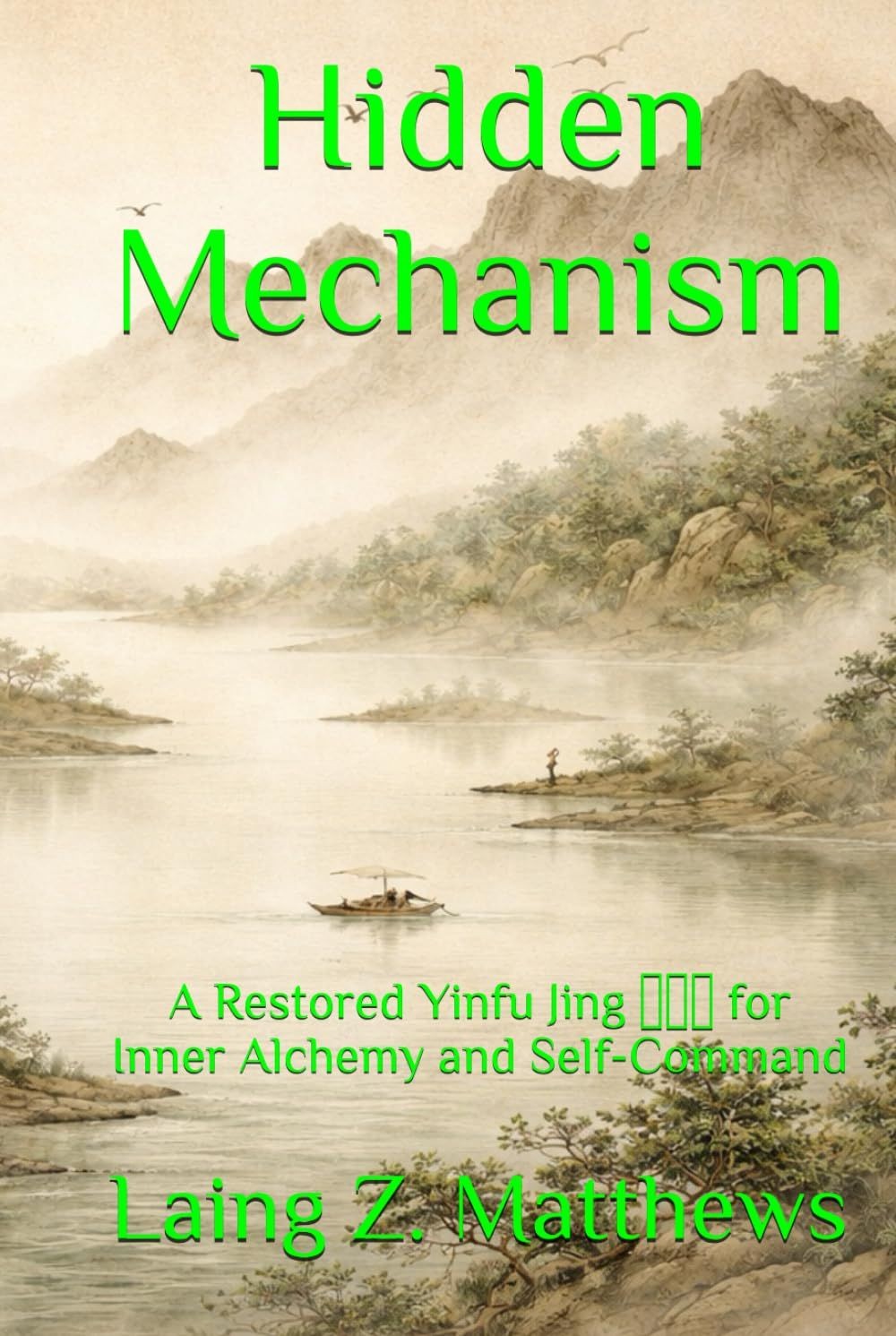
Hidden Mechanism Yin Fu Jing陰符經
Hidden Mechanism is a modern restoration of the Yin Fu Jing—one of the most compressed and controversial classics attributed to the Yellow Emperor—presented as a working manual for inner alchemy, self-command, and ordinary-life regulation.
The Yin Fu Jing is famously brief, transmitted in multiple versions, and interpreted across centuries in competing ways: as a statecraft and strategy text, as Daoist doctrine, and as an inner cultivation instruction. This book does not treat it as a museum piece, and it does not turn it into mystical cosplay. It translates the text in clear English, then restores its internal logic through disciplined commentary that explains what each line is doing, what error it corrects, and how its mechanism applies to modern life.
The core claim is blunt: the theft is the mechanism. What drains you is not usually dramatic. It is automatic. It runs through the senses, habits, triggers, and unconscious escalations that steal sleep, fracture attention, harden speech, and turn impulse into destiny. Modern life industrializes these vulnerabilities—screens weaponize the eyes, noise trains vigilance, outrage converts attention into heat, and frictionless consumption trains compulsion. The result is a life “operated” by invisible automation while the person calls it choice.
Hidden Mechanism is written to end that trance.
This is an anti-hype, pro-verification book. It refuses instant-awakening salesmanship, power fantasies, and strain-based “discipline.” No breath forcing. No deprivation cult. No vague mysticism as a substitute for explanation. The method is traditional in spine and modern in clarity: measure, timing, reduction, and return. Each unit includes practical implications and simple verification so the reader can test whether the teaching is producing real direction—steadier mind, reduced compulsions, cleaner speech, faster recovery after disturbance, and more reliable ethics under pressure.
The commentary is structured, not ornamental. Variants are handled honestly without drowning the reader in catalog trivia. Where alternate readings matter, they are treated as pressure-tests that clarify meaning. Where they do not matter, they are ignored. The aim is not to win scholarly arguments; it is to restore a classical instrument that can govern an actual life.
This book is for serious readers who want the Yin Fu Jing intact and intelligible, and for practitioners who want inner alchemy without theatrics: a disciplined craft of transformation proven in ordinary life. If the mechanism is seen, escalation stops. When measure returns, the body stabilizes. When timing is restored, craving weakens. When speech is governed, ethics becomes reliable. That is the standard. Those who perceive them flourish—not because they collected ideas, but because the hidden machine stopped pretending to be them.
Cutting Through Illusion 翠虚篇
Cutting Through Illusion presents the Cuixu Pian, a Southern lineage classic of Daoist inner alchemy attributed to Chen Nan, in a clear English translation designed for serious readers who want meaning, not mystique.
Inner alchemy literature is famous for beautiful coded language: sun and moon, lead and mercury, furnaces and cauldrons, lords and maidens, matchmakers and bridal chambers. Read well, these images function as a precise mirror of inner work. Read poorly, they become a trap: calendar superstition, chemistry literalism, vocabulary collecting, and “shortcut spirituality” that confuses strain for attainment.
This volume is built to prevent those errors.
You receive a clean, readable translation that stays close to the original movement of the lines, supported by a strict editorial method: micro-notes only where needed to prevent wrong readings, and full commentary kept in dedicated sections so the text is never buried under lectures. The result is a book you can actually read like a classic: line by line, return by return, with corrections where they matter and silence where they does not.
Inside you will find:
A stable base-text approach that avoids turning the book into an academic apparatus.
A simple numbering system for cross-reference and study.
Dedicated commentary “scenes” that expose the tradition’s most common counterfeit readings: timing obsession, measurement fixation, material literalism, and the urge to chase special effects.
A safety-first practice stance: no breath-holding, no forced breathing, no strain, and no deprivation sold as spiritual proof.
This is not a dare. It is not a “secrets” book. It is not an attempt to turn Daoist symbolism into modern motivational language. It is a disciplined encounter with a demanding text, presented with clear boundaries and old-school seriousness.
The core claim is simple and blunt: there is one governing principle behind the flood of names. Get the One, and the ten thousand become readable. Miss it, and you can wander for a lifetime.
If you want a translation that respects the tradition without flattering the reader, and commentary that clarifies without inflating, Cutting Through Illusion delivers a classic in the only form that matters: usable, rigorous, and grounded.
Part of series
The Taoist Inner Alchemy Classics
Print length
243 pages
Language
English

Teachings for Beginners: Sayings of Master Qiyun: A Translation and Commentary on Seeing Clearly, Hearing Clearly, and Returning to the Right Way
Teachings for Beginners is not a book of inspirational quotations. It is a training manual disguised as plain speech. It is for readers who are tired of collecting spiritual ideas and ready to be corrected by something older, harder, and more honest than modern self-help.
These sayings come from a traditional Daoist cultivation environment where progress is not measured by moods, visions, or clever interpretations, but by conduct: how you speak when irritated, what you do when nobody is watching, how quickly you recover after disturbance, and how steadily you can live without craving drama, praise, or spiritual status.
Beginners need two things more than anything else: a clear standard and a reliable method of correction. Most modern books offer neither. They offer comfort, excitement, or endless “possibilities.” That feels good for a week. Then life returns, habits return, and the reader quietly concludes that “spirituality doesn’t work.” In truth, the problem is not the Way. The problem is that the reader was never given a functional training structure, and never shown the real enemy: self-deception, scattered attention, and ungoverned desire.
Master Qiyun does not teach by building a comforting worldview. He teaches by exposing the mechanics of error: impatience, grasping, complaint, fantasy, and the hidden demand that life should treat you as special. He also shows what a stable path looks like: simplify, return to the root, correct one thing at a time, and stop seeking shortcuts that inflate the ego while leaving conduct untouched.
Each saying is followed by commentary that restores the internal logic for modern readers in clear English. The aim is not to turn the tradition into a museum piece (scholarship with no application) or cosplay (how-to without clarity, context, or ethics). It is to keep the spine intact while keeping the text usable. The commentary clarifies what a passage is doing, what mistake it is correcting, and how to apply it without turning practice into theatre.
This book is deliberately anti-hype. It refuses vague mysticism as a substitute for explanation. It also refuses forced physiology claims designed to impress skeptics. The reader is treated as an adult: capable of discipline, capable of restraint, capable of being corrected without being coddled.
The method is simple and traditional: take one saying, apply one correction, and test it in ordinary life. Progress is measured by behavior under pressure—less reactivity, cleaner speech, reduced compulsions, stronger recovery after disturbance, and more reliable ethical behavior. If a method cannot survive ordinary life, it is not refinement; it is entertainment.
Read slowly. Apply one teaching at a time. Let results—not excitement—decide what is true.

The Embryonic Breathing: Four Essential Texts with Translation and Commentary 胎息
Embryonic breathing is one of the most misunderstood phrases in Daoist cultivation. In modern hands it is often reduced to breath tricks, forceful retention, or exotic claims. In the classical tradition it points to something simpler, stricter, and more demanding: returning breath and mind to their original harmony until respiration becomes quiet, continuous, and governed by stillness rather than will.
The Embryonic Breathing presents an English translation of the core Embryonic Breathing Classic (Taixi Jing) together with a practical, historically grounded commentary. The aim is not to sell a shortcut, but to restore the text’s real meaning: breath as a mirror of inner governance. When the heart-mind is scattered, breathing becomes scattered. When the heart-mind is unified, breathing becomes unified. When the heart-mind rests, breath rests.
This book takes the ancients seriously without asking the reader to suspend intelligence. It explains what the text is claiming, why it was written the way it was written, and how to read its strongest lines without turning them into harmful instructions. The commentary separates doctrine from misunderstanding: phrases often misread as breath suppression are treated as statements about settled awareness and refined respiration. The training emphasized here is gentle, non-forcing, and rooted in the older Daoist standard of measure and longevity rather than intensity and spectacle.
Because breathwork has become a modern marketplace, the book also functions as a filter. It names the common errors that create instability: forcing depth, chasing numbness, locking the throat or diaphragm, measuring progress by sensation-chasing, and confusing temporary altered states with genuine refinement. In place of that, it offers a traditional alternative: long-term stability, clean sleep, steady mood, clear perception, and improved conduct in ordinary life. Progress is framed as steadiness, not fireworks.
The translation is kept clear and readable, while the commentary stays concrete. Key phrases are unpacked in plain English, technical images are explained without hype, and traditional claims are presented with two honest lenses: a classical reading that treats the tradition on its own terms, and a mechanism-first reading that focuses on attention training, physiology, and behavioral stability. Readers can adopt either lens, or let both coexist, without losing the thread of practice.
Included is practical, usable material: the root text in English; line-by-line explanation; a map of what “embryonic” means in cultivation language (returning toward original vitality, not imitating an unborn body); guidance on posture, stillness, and gentle attention; troubleshooting for common problems such as agitation, sleep disruption, pressure sensations, and obsessive monitoring; and clear contraindications for anyone with panic tendencies, unresolved trauma patterns, breathing disorders, or a history of forcing meditation. The book repeatedly rejects breath holding as a “secret,” and insists on the Daoist principle of non-forcing: heart and breath resting together.
The Embryonic Breathing is written for serious practitioners, translators, and readers of Daoist inner alchemy who want the doctrine underneath the slogans. It is also for modern readers who have encountered aggressive breath culture and want a safer, more traditional path that respects the body and refuses spiritual bravado. This is not a collection of hacks, intensity protocols, or breath stunts. It is a return to the old standard: refine conduct, refine mind, and let breath become honest.
If breath is life’s most constant movement, then learning to govern it without violence becomes a foundational craft. Properly understood, embryonic breathing is not an escape from the body.

The Yellow Court Classic: Outer Scripture: A Classic of Organ Nourishment and Spirit Stability黄庭外景
A modern, sober, and deeply practical English edition of the Yellow Court Classic: Outer Scripture—one of the foundational Daoist texts on inner cultivation, energetic governance, and the restoration of vitality through clarity, restraint, and right timing.
This book is not presented as fantasy, superstition, or a sightseeing tour through “mystical realms.” It treats the Outer Scripture as what it has always been at its best: a manual of governance. The language is classical and symbolic—gates, courts, palaces, spirits, colors, elixirs—but the method beneath it is consistent: reduce leakage, stabilize the center, regulate the breath without forcing, and let the body’s own reserves rebuild. When the old writers speak of “immortality,” this edition does not sell miracle promises. It translates the claim into the measurable fruits the tradition actually tests: steadier mind, stronger recovery, calmer sleep, improved resilience, cleaner conduct, and a life less ruled by compulsion.
The volume is built in two complementary parts.
Part One presents a clear English translation of the Outer Scripture with grounded commentary aimed at modern readers. Symbolic passages are rendered as functional instructions. Common misreadings are corrected. High-risk phrases are handled carefully—especially anything that could be mistaken for breath-holding, aggressive control, or extreme deprivation. The aim is not to sanitize the text, but to restore its true intent: a quiet, precise discipline that strengthens life instead of burning it up. Throughout, the commentary keeps returning to the classical standard of proof: not visions or claims, but the fruit of practice in daily life—more stability, more honesty, faster recovery, less reactivity, and greater clarity under pressure.
Part Two presents Wuchengzi’s traditional commentary as the primary classical witness, with the commentary translated into English and accompanied by concise notes. This anchors the reader in traditional interpretive logic—how Daoist authors mapped the body, named inner functions, and encoded cultivation steps in courtly metaphor. Where older shorthand can sound forceful or sensational in modern ears, the notes clarify likely intent, distinguish symbol from literalism, and include safety cautions where misuse is common today. The goal is to let the tradition speak for itself while preventing the predictable modern mistakes that turn “governance” into strain.
This is a book for serious readers: meditators, students of Daoist internal arts, translators, and anyone who wants a traditional text presented with both reverence and honesty. It is also for exhausted modern people who sense that the deepest medicine is not another hack, but the return to measure: quieter living, a steadier mind, and a body no longer treated like a disposable furnace.
The Outer Scripture does not ask you to believe. It asks you to govern.

The Yellow Court Classic: Inner Scripture: A Foundational Daoist Manual of Inner Cultivation and Spiritual Governance黄庭内景
The Yellow Court Classic: Inner Scripture is not a book of beliefs. It is a classical manual of inner governance—how the human being becomes coherent from the inside out.
The Inner Scripture is one of the foundational Daoist texts on inner cultivation. It speaks in the language of palaces, officials, banners, gates, and storehouses. Modern readers often mistake this imagery for superstition, or they treat it as fantasy. This edition takes a different approach. It preserves the classical symbolic grammar while translating it into plain, workable meaning: the body as an inner estate, the mind as its ruler, and vitality as a resource that can be conserved, squandered, refined, and restored.
This volume is built for slow, practical reading. Each passage is presented in three layers. First comes the English translation of the scripture. Next comes a traditional note from Wuchengzi, preserving the original interpretive logic and the old correspondence system. Finally, a modern commentary clarifies mechanism and application without sensationalism. The aim is not to impress the reader with mystical claims, but to restore a usable map: how perception becomes clear, how appetite and emotion are regulated, how fear and anger are governed, how reserves are sealed, and how the whole system returns to rhythm.
The text repeatedly emphasizes a conservative doctrine. Do not force breath. Do not strain the body. Do not chase visions or powers. If practice makes you wired, fragile, obsessive, or sleepless, you are going in the wrong direction. The real test is ordinary life: steadier sleep, calmer emotion, cleaner boundaries, stronger digestion, faster recovery after stress, and a mind that is less easily scattered by craving and fear. In this tradition, “long life” is not a sales promise; it is the outcome of reduced leakage and restored coherence.
The Yellow Court Classic has endured because it deals with permanent realities. A person either has inner government or does not. When the inner estate is coherent, the hundred functions align. When it is not, the functions fight, the reserves drain, and life becomes reactive and costly. This book offers a sober, verifiable approach to Daoist cultivation for readers who want the old tradition without modern confusion—reverent toward the ancients, critical about forcing, and grounded in results.
This is a translation, a commentary, and a training in how to read classical Daoist inner texts correctly: as administrative maps of the living human being.

Bai Yuchan on Inner Alchemy 白玉蟾: Pointing to the Mystery Gateway (Zi Qing Zhi Xuan Ji)
Bai Yuchan on Inner Alchemy gathers a major body of Southern Lineage teaching from the Song period and presents it as a usable map for modern readers: clear, conservative, and allergic to fantasy. Bai Yuchan (also transmitted under the name Ge Changgeng) is remembered in later tradition as a leading inner-alchemy voice not because he promised miracles, but because he refused confusion. He could speak in the old symbolic language without letting symbols harden into superstition, breath forcing, or spiritual sightseeing.
This volume focuses on prose teachings: short essays, questions and answers, corrective talks, and practical explanations. The purpose is not to impress you with ornate “lead-and-mercury” poetry. It is to remove error. In internal alchemy, error is not harmless. It pushes people toward strain-based methods, obsessive timing games, and the pursuit of sensations. Bai’s best pages keep dragging the reader back to first principles: images are pointers, not objects; names are teaching devices, not substances; and the real work is restoring coherence by reducing leakage.
Included here are major prose selections such as On the Ascent and Descent of Yin and Yang (Yinyang Shengjiang Lun), Inquiring About the Way in Crane Grove (Helin Wendao Pian), and Sayings from the Elixir Chamber, with Hu Taixian (Dan Fang Fayu). These texts move from cosmological mechanism to embodied practice: the yearly and daily rise-and-fall of yin and yang; the “middle” as the gathering place of the two breath-forces; the classic rule that spirit staying is life and spirit leaving is death; and the return-elixir logic that stands behind Golden Liquid language.
This edition is built for use. Each section is presented in three parts: a close translation, a clean English rendering, and commentary that explains mechanism, identifies metaphor, and names the traps that injure readers. The commentary does not try to modernize Daoism into self-help, and it does not flatter the reader with promises. It treats the old teachings as potentially true, while also speaking plainly about misuse: clamping or manipulating the breath, courting sleeplessness and agitation, turning correspondences into compulsions, and mistaking symbolic talk for literal objects.
Bai Yuchan also preserves a practical hierarchy. He does not present “one method for everyone.” He distinguishes levels of capacity and warns against grabbing ornate methods and forcing them onto an unready life. At the top end, the work leans toward stillness, clarity, and simplified means. In the middle, it uses regulation and timing as supports. At the bottom, it can lean into heavier scaffolding—and he warns how easily that turns into obsession. This is not a book for thrill-seekers. It is for readers who want inner alchemy without delusion, without strain, and without hype.
If you are tired of mystical jargon, this book will feel like a relief. If you have been burned by aggressive breathwork or compulsive “energy” chasing, it will feel like a correction. The standard here is old and severe: natural breathing, stable living, and a daily return to the center without strain. The fruit of correct work is ordinary and measurable—steadier sleep, calmer emotion, cleaner boundaries, stronger digestion, and faster recovery under stress. Bai Yuchan does not sell escape. He teaches residence. He does not promise that you will become special. He insists that you can become whole.

Zhang Sanfeng: The Essential Keys of Inner Alchemy: Core Texts for Building the Foundation and Refining the Elixir
In this volume, the inner alchemy teachings attributed to Zhang Sanfeng are restored as what they were meant to be: a working manual for real refinement, not a shelf ornament, and not a superstition kit.
Modern readers often meet Daoist cultivation through fragments—quotes, motivational “wisdom,” or sensational claims. The original tradition is stricter and more practical. It insists on measure. It insists on stages. It insists that spirit-work without ethical restraint becomes delusion, and technique without stability becomes strain. This book returns to that older standard.
The text is translated into clear English and paired with disciplined commentary. The translation gives the spine: the traditional sequence of principles, warnings, and methods. The commentary restores the joints: what the author is correcting, what common misreadings distort the meaning, and how the instructions function in actual practice. Where the tradition is direct, the translation stays direct. Where the tradition speaks in compressed shorthand, the commentary expands it without turning it into modern therapy-talk or vague poetry.
You will find repeated emphasis on fundamentals that many readers want to skip: regulating desire, calming the heart-mind, refining breath without forcing, sealing leakage, rebuilding reserves, and cultivating steadiness that holds under pressure. The old texts are blunt for a reason. Inner alchemy can become dangerous when treated as entertainment, identity, or escalation. The training is meant to produce a person who is more stable, more coherent, and harder to disturb—not someone addicted to phenomena.
This volume also keeps the traditional boundary between symbolism and literal instruction. Daoist writing uses imagery—fire and water, sun and moon, cauldrons and medicines—but it is not a license to fantasize. Symbols are functional shorthand. The commentary makes that function explicit, distinguishing effects from attainment and signs from substance. If you want fireworks, you will be disappointed. If you want a sober method, you will recognize the value immediately.
The Taoist Inner Alchemy Classics series is built on a simple premise: a classic deserves to be readable, guarded, and testable. The test is not what you can claim, and not what you can imagine. The test is conduct and resilience: better sleep, steadier appetite, less reactivity, cleaner desire, faster recovery from stress, clearer attention, and a mind that can return to stillness without drama. Those are traditional measures, not modern compromises.
This book is for serious readers: practitioners, scholars, and disciplined beginners who want the old art the old way—clear, conservative, and rooted in the hard-earned realism of the ancestors. If you use it properly, it will not make you feel special. It will make you more steady. And that is exactly what the tradition intended.
Translated and commented by Laing Z. Matthews.

The Classic Manual of Nature-and-Life Cultivation 性命雙修萬神圭旨: A Complete Translation and Commentary of the “Ten Thousand Spirits” Inner Alchemy Guide, Vol. 1
Xingming Guizhi: The Classic Manual of Nature-and-Life Cultivation, Vol. 1 presents one of the clearest traditional roadmaps for Daoist inner work ever compiled: how to refine clarity (Nature) and vitality (Life) together, without lopsided practice, mystical inflation, or empty theory. This volume offers a complete English translation with detailed commentary of the “Ten Thousand Spirits” inner alchemy guide, preserved in classical manuals for building the foundation, sealing the leaks, gathering what has been scattered, and returning to the root.
The tradition speaks in coded language—cauldrons and furnaces, gates and palaces, lead and mercury, dragon and tiger. To modern readers, that vocabulary can feel remote. Yet behind the imagery is a sober, technical system concerned with one question: can the human being be made coherent again? Xingming Guizhi answers by insisting on sequence. It distinguishes outward quiet from inward transformation, breath tricks from true stabilization, and imagined progress from verifiable change. It treats visions and sensations as unreliable, and places the real measure of attainment where it belongs: steadier mind, cleaner conduct, deeper rest, stronger reserves, and a reduced tendency to scatter energy through agitation, excess, and careless living.
Vol. 1 establishes the foundation. It explains how the classics frame the relationship between Heaven and the human body, and why “inner breathing” is not simply the air moving through mouth and nose, but a subtle opening-and-closing within the body’s root axis. It clarifies the traditional geography of the work—the true breathing place, the storage of original essence, the return of spirit to the “qi穴,” and the difference between external breathing that nourishes the ordinary body and internal breathing that cultivates the Valley Spirit. Along the way, it presents a wide range of short oral-key verses that transmit the hinge of method in compact symbolic form, then unpacks them without forcing literal anatomy onto poetic names.
This is not a modern self-help adaptation. It is a classical manual presented as technical literature: translated for readability, rendered more closely where needed for precision, and commented upon to prevent the two great failures of alchemical reading—treating everything as metaphor and therefore doing nothing, or treating everything as literal physiology and therefore doing harm. Where the old tradition contains dangerous currents—reckless forcing, breath retention, rage-driven methods, or claims that invite naïve imitation—this edition names the risks plainly, and returns the reader to the safest standard: coherence over spectacle, sobriety over excitement, verification over belief.
Readers interested in Daoist meditation, internal cultivation, classical Chinese spirituality, and the logic of inner alchemy will find in this volume a disciplined guide to the foundational stages: gathering, sealing, storing, and returning to root. Vol. 1 prepares the reader to understand later process-signs and diagrams without confusion, and it sets the compass for the series: Nature and Life are cultivated together, or the work collapses into imbalance.
For serious readers who want the old manuals without the fog, Xingming Guizhi offers a clear entrance: a grounded translation, a practical commentary, and a traditional insistence that the real proof is not in extraordinary experiences, but in the quiet, measurable restoration of inner governance.

The Classic Manual of Nature-and-Life Cultivation 性命圭旨: A Complete Translation and Commentary of the “Ten Thousand Spirits” Inner Alchemy Guide, Vol. 2
This book is a clear English translation and commentary of a traditional Daoist cultivation manual, presented as a working text rather than a belief system. It is not a modern medical handbook, and it does not sell fantasies of instant awakening or supernatural rank. Its subject is order: what preserves vitality, what leaks it, how the inner life becomes governable, and what counts as real progress when glamour is removed.
Classical inner-cultivation literature is often distorted in the modern market. One camp turns it into vague poetry: inspiring language, soft “energy talk,” and little that can be tested. Another camp turns it into aggressive technique: forcing breath, forcing sensations, and forcing meaning onto whatever happens inside the body. Both approaches produce predictable wreckage—confusion, instability, and years spent cultivating substitutes. Traditional manuals were written to prevent exactly that. Their tone is closer to engineering than spirituality: sequence, measure, timing, conservation, and the refusal to certify smoke as fire.
“Nature-and-life cultivation” names the old insistence that clarity of mind and stability of vitality must be handled together. Insight without a stable base becomes brittle and easily disturbed. Vitality work without clarity becomes unstable, prideful, and easily hijacked by appetite. This text insists on the same standard again and again: the work is proven by what it produces in conduct and stability under ordinary life pressure, not by private experiences, inner fireworks, or mystical vocabulary.
This edition is built to be readable, testable, and difficult to misread. Each passage is presented in three layers: translation, a plain English restatement, and commentary that clarifies what the line is doing, what error it corrects, and what modern misreading it tends to trigger. The commentary is deliberately anti-hype. It does not flatter recklessness. It does not romanticize secrecy. It states the tradition’s warnings plainly, including where classical language can tempt harmful forcing, obsessive pursuit of sensations, or confused interpretations that drive pressure upward and call it attainment.
This volume contains two parts, drawn from two traditional collections. The aim is not to bury the reader in parallel apparatus, but to provide two witnesses while keeping the spine of the craft visible: the same old principles restated in different idioms, so the operating logic becomes harder to distort.
Across both parts, the manual circles a small set of demands. Conserve what leaks. Regulate appetite, speech, attention, and sleep. Distinguish ordinary circulation from the subtler “medicine” language of real consolidation. Refuse trance and blankness as substitutes for stillness. Refuse intensity as a proof of correctness. Keep measure. Build something that endures.
This book is for readers who want a traditional manual in clear English without theatrics—readers who are willing to trade hype for clarity, shortcuts for sequence, and private excitement for durable change. It offers no miracles, only a pattern that has survived because it corrects predictable human error. If approached with humility and patience, the text stops being ornamental and becomes functional: a manual of inner governance, teaching how to conserve, gather, refine, and verify—without forcing, without cosplay, and without self-deception.

Huang Yuanji on Inner Alchemy and the Mysterious Pass: Recorded Sayings from the Hall of Joyful Nurturing: Le Yu Tang Yu Lu 《樂育堂語錄》
Huang Yuanji on Inner Alchemy and the Mysterious Pass brings one of late–Qing era China’s most practical Daoist voices into clear English. Drawn from the Le Yu Tang tradition, these “recorded sayings” capture live, spoken instruction: what a teacher actually emphasized when students were present, confused, distracted, or eager to rush ahead. The result is not poetry for armchairs, but a working manual of mind, breath, spirit, and conduct—what to do, what to stop doing, and what to watch for when the practice begins to “answer back.”
This volume presents a complete translation of selections from 《樂育堂語錄》 (Le Yu Tang Yu Lu) alongside a grounded commentary meant to keep the reader oriented. The text returns again and again to the core problem of Daoist cultivation: people want results, but they neglect the foundation. Huang Yuanji’s method is sober: quiet the heart, reduce leakage, guard the center, and let the real work ripen in its own season. The “Mysterious Pass” is treated not as a fantasy location, but as a crucial pivot of attention and vitality—subtle, easily faked by imagination, and only stabilized through steady refinement.
Inside you will find:
A coherent map of the inner-alchemy pathway, from basic moral and emotional regulation to deeper stillness and internal transformation.
Direct instruction on collecting the scattered mind, sealing “leakage,” and rebuilding internal coherence without strain.
Plain explanations of classical terms and images—fire and water, lead and mercury, pass and gate—so the reader can follow the logic instead of memorizing slogans.
Warnings about common traps: forcing sensations, chasing experiences, and turning practice into a story machine.
A traditional approach to verification: the true measure is conduct—clarity, restraint, resilience, and steadier virtue under pressure.
This book also tells the truth about the broader Daoist landscape. Classical lineages contain claims and methods that modern readers should treat with caution: literal spirit-summoning, talismanic operations, weather manipulation, external thunder magic, and even violent exorcistic “killing” formulas appear in parts of the tradition. This volume does not train those arts. It stays with inner cultivation and the disciplined building of the foundation. It also rejects breath-retention bravado: no breath holding, no forcing, no self-harm disguised as “power.” When the body and mind destabilize, the correct move is simplification and stabilization—not escalation.
Huang Yuanji’s gift is that he speaks like a teacher who has seen the same errors for decades and refuses to flatter them. The tone is respectful toward tradition, but not gullible; serious about attainment, but hostile to delusion. For readers who want Daoist inner alchemy as a real craft—structured, testable, and lived—this book is a straight road with guardrails.

Chen Zhixu — The Great Essentials of the Golden Elixir: A Complete Translation and Commentary of Jindan Dayao
Chen Zhixu’s Jindan Dayao (The Great Essentials of the Golden Elixir) is a compact, hard-edged guide to the real work of Daoist inner alchemy: what matters, what is noise, and what ruins practitioners who mistake ideas for attainment. In a field crowded with vague inspiration and modern “energy talk,” this text speaks in older, sharper terms—principle, method, timing, verification, and the lived consequences of deviation.
Rather than treating inner alchemy as a set of poetic metaphors, Jindan Dayao insists on concrete internal governance: how the mind must be trained, how desire and scattered attention sabotage the work, why “knowing” and “doing” are not the same, and how the genuine stages reveal themselves through stable changes in conduct, clarity, and inner coherence. It is a manual for serious readers—those who want a faithful transmission of classical language, plus plain English explanation that does not flatter, mystify, or dilute.
This edition presents a complete English translation with commentary designed for modern readers while staying loyal to the text’s original intent. The translation aims to be direct and sentence-faithful, and the notes clarify key technical terms, common misreadings, and the practical logic behind the author’s warnings. When the tradition points toward methods that can be misused—obsession with experiences, forcing techniques, rage-inducing approaches, or hazardous breath retention—this volume does not romanticize them. It explains what the old authors were trying to do, why they believed it worked, and why modern practitioners must be cautious and sane.
For readers building a classical foundation, Jindan Dayao functions as a “compass text”: it helps sort the essential from the theatrical. For experienced practitioners, it is a corrective—an older voice that cuts through drift and calls the work back to discipline, timing, and proof.
Inside you will find:
A complete translation of Chen Zhixu’s Great Essentials
Clear commentary that explains the logic of the stages and the role of mind, breath, and internal order
Warnings against common failures: chasing visions, mistaking concepts for realization, and forcing the body
Traditional principles presented without modern cosmetic gloss
If you want inner alchemy as a lifestyle brand, this is the wrong book. If you want the classical “golden elixir” tradition as it actually reads—serious, practical, and uncompromising—this is a strong place to begin.

Fu Jinquan — The Female Golden Elixir: Essential Teachings 女丹: Immortal-and-Buddha Harmonized Inner Alchemy Methods
Fu Jinquan’s Female Golden Elixir: Essential Teachings is a rare inner-alchemy manual written for women inside the classical Daoist cultivation tradition. It is not a modern “adaptation,” not a poetic inspiration book, and not a wellness rebrand. It is a working text—tight, practical, and warning-heavy—built around method, timing, discipline, and proof.
“Female Golden Elixir” points to a real historical stream: women cultivated, transmitted, and preserved inner-alchemy teachings, and specific guidance developed that matched women’s lived conditions without lowering the standard. This book assumes seriousness. It treats cultivation as internal governance: the mind must be trained, attention must be conserved, desire must be regulated, and emotional turbulence must be settled. Progress is not measured by dramatic experiences, visions, or “energy highs,” but by durable changes that show up in ordinary life—steadier conduct, cleaner speech, less compulsion, calmer reactions, and faster recovery under pressure.
The subtitle, “Immortal-and-Buddha Harmonized Inner Alchemy Methods,” reflects the late classical world where Daoist, Buddhist, and Confucian language often ran together in practical teaching. This is not modern mash-up spirituality. It is an older, hard-nosed logic: if the mind is unstable, methods become harmful; if conduct is crooked, practice becomes self-deception; if timing is ignored, effort becomes strain. The tradition does not reward enthusiasm. It rewards correctness and steadiness.
This edition presents a complete English translation with clear commentary. The translation is direct and readable while staying loyal to the text’s intent. The commentary clarifies key terms, common misreadings, and the practical reasoning behind the author’s warnings. Where older materials hint at practices that can be misused—fixation on “signs,” overstimulation of the nervous system, forcing concentration, or using breath in strained ways—this volume refuses to romanticize them. It explains what the older authors aimed at, why they thought it worked, and how a modern reader can approach the material without reckless escalation.
Readers coming from modern meditation culture will recognize themes like stillness and attention, but inner alchemy does not stop at “calm.” It is structured training: stabilizing the mind, collecting scattered attention, restoring internal order, and building a foundation that can bear deeper transformation. Again and again the text draws a line between intellectual understanding and lived change. It treats experience-chasing as a major failure mode. It treats imagination as both tool and trap. It insists that cultivation should produce coherence—more resilience, more honesty, and more ethical clarity—not paranoia, grandiosity, secrecy, or fragility.
For newcomers, this is a guardrail text: it teaches a sober relationship to practice and offers a classical self-check that still works today. For experienced practitioners, it is a corrective: an older voice that cuts through drift, technique-collecting, and vague “energy talk,” returning the work to fundamentals.
This book is for readers who want the Golden Elixir tradition as it actually reads on the page—serious, exacting, and practical—and who want a women-centered classical teaching text presented in clear English without dilution or modern cosmetic gloss.

The Yin–Yang Elixir 孫汝忠金丹真传: Sun Ruzhong’s Teachings on Dual Cultivation and Inner Alchemy
The Yin–Yang Elixir is a clear, faithful presentation of Sun Ruzhong’s inner-alchemy teaching on dual cultivation—how yin and yang, essence and breath, spirit and mind are refined together into a single coherent path. In a field crowded with vague mysticism, modern self-help gloss, or sensationalized “bedchamber” gossip, this book takes the old road: careful wording, disciplined practice, and a sober respect for what the tradition claims.
Sun’s teaching treats the human being as an alchemical vessel. Life is not improved by force, fantasy, or mere belief; it is transformed by timing, restraint, and correct method. “Dual cultivation” is not pornography disguised as spirituality. At its best, it is the cultivation of harmonized polarity—two people training the same core principles of stillness, circulation, containment, and return. The goal is not pleasure, performance, or emotional intoxication. The goal is refinement: stabilizing spirit, gathering genuine vitality, and converting scattered desire into usable power.
This volume does not treat these teachings as a toy. It keeps the reader grounded in the reality that classical manuals often speak in veiled language—partly to protect the unready, partly to prevent casual misuse, and partly because some operations cannot be stated bluntly without producing misunderstanding. Where Sun hints, this translation helps the reader see the direction of the hint without turning the book into lurid instruction. It makes the concealed structure legible: yin and yang as functions; fire and water as inner operations; “medicine” as real energetic substance; “timing” as the hinge of success and failure.
You will find a strong emphasis on moral and mental conditions, because the old masters insisted on it: greed, agitation, vanity, and compulsion ruin the furnace. You will also find a recurring insistence on moderation and safety. The tradition contains dangerous corners—breath retention hazards, rage-inducing methods, delusional spirit-chasing, and the temptation to treat the work as literal power-magic. This book does not romanticize those corners. It names the risks plainly, and returns the reader to what holds up under pressure: calm attention, steady practice, clean conduct, and verifiable changes in character.
Laing Z. Matthews presents the text in lucid English while preserving its classical intent. The result is a serious working volume for readers who want the authentic Daoist approach to inner refinement—whether practiced individually or as a disciplined partnership. If you are seeking a respectable, non-sensational door into the yin–yang method as it is actually taught in the old world—this is that door.

The Golden Elixir Set Straight 陸西星: Lu Xixing’s Core Texts on the Eastern School Method
The Golden Elixir Set Straight presents the core inner-alchemy writings of Lu Xixing, one of the most influential voices associated with the so-called Eastern School approach to Daoist cultivation. This volume is built for readers who want the tradition in its own terms: concise source texts, clear translation, and direct explanation that does not romanticize the work or turn it into vague “spirituality.” Lu’s project is simple to state and difficult to carry out: correct the reader’s understanding of what the Golden Elixir actually is, strip away popular errors, and return practice to principle, timing, and verification.
At the center of these texts is a sober insistence that inner alchemy is not metaphor-only poetry and not crude externalism either. Lu repeatedly separates genuine method from counterfeit shortcuts: empty talk, self-hypnosis, forced techniques, and the endless chasing of sensations. He treats the tradition as a technology of transformation governed by law-like sequences. The language is classical, but the intent is practical: establish the root, regulate the inner economy, and avoid the two most common disasters—leaking vitality through appetite and fantasy, or injuring oneself through force and impatience.
Readers will encounter the hallmark Eastern School emphasis on clarity, order, and proper progression. “Setting straight” means restoring correct orientation: what is primary and what is secondary; what is cause and what is effect; what is a sign and what is wishful thinking. Lu’s writings work like a physician’s diagnosis of spiritual error. He points out how people mistake agitation for power, visions for attainment, and clever theories for the medicine itself. He also explains why the old teachers spoke in guarded language. The art can be abused, misunderstood, or reduced to indulgence. That risk is not hidden here. This book names it plainly, then returns to what the tradition considers safe and real: discipline, restraint, timing, and steady refinement.
The “Eastern School method” in this volume is presented as a coherent path rather than scattered sayings. It includes how to recognize authentic prerequisites, how to avoid “starting at the end,” and how to measure progress without superstition. Lu is especially sharp on the problem of time. Many readers drift until strength declines, then treat cultivation as a last-minute rescue plan. These texts answer with an older, harsher truth: the work is easiest when vitality is strong, and delay quietly steals the very material required for completion. This is not moralizing. It is mechanics. A furnace cannot run without fuel.
Although Lu writes within the inner-alchemy tradition, the reader will also see why later lineages read him as a corrective to extremes—both the purely “mind-only” approach that denies the body, and the purely “body-only” approach that becomes obsessive and coarse. The Golden Elixir, as framed here, is neither a slogan nor a chemical substance. It is the completed integration of essence, breath, and spirit into a stable, unified basis that can be preserved, deepened, and carried through changing conditions. In traditional terms, it is a true accomplishment that shows in conduct, not just in experiences.
This volume is aimed at serious readers: practitioners who want clean sources, translators and scholars who want a faithful presentation, and newcomers who want a truthful map instead of mystical fog. It does not promise quick results or theatrical powers. It offers something rarer: a classical master’s attempt to rescue a profound method from misunderstanding, and to put the reader back on a path where claims are tested by sequence, stability, and the long patience of real work.

The I Ching Cantong Qi Explained 周易參同契解: Chen Xianwei’s 1234 Commentary on Wei Boyang’s Cantong Qi, the Alchemical Classic
In The I Ching Cantong Qi Explained 周易參同契解, Laing Z. Matthews presents a clear, practice-aware reading of one of Daoism’s most influential alchemical texts: The Cantong qi (“The Seal of the Unity of the Three”), traditionally attributed to Wei Boyang. This volume is built around Chen Xianwei’s Cantong qi commentary and is designed to do one thing well: make the text intelligible in plain English without flattening its technical depth.
The Cantong qi is famous for blending three languages at once—I Ching change logic, cosmological correspondences, and alchemical operations. That blend is also exactly why so many readers bounce off it. Chen Xianwei’s commentary is valuable because it tries to pin down what the lines are doing: when the text is speaking in images, when it is speaking in numbers and cycles, and when it is speaking in the coded grammar of the alchemical work. Matthews carries that clarifying intent into a modern presentation, translating key passages and then walking the reader through how the commentary reads the symbols.
Rather than treating the Cantong qi as “mystical poetry,” this book treats it as a manual written in a deliberately veiled style. The goal is not to sensationalize “secret teachings,” but to restore the traditional way these works were actually used: read slowly, tested against lived discipline, and checked against results in conduct, stability, and clarity. The commentary helps the reader see recurring structures—yin and yang exchange, the timing of phases, the logic of reversal, and the repeated insistence on order, measure, and restraint.
This volume is also blunt about the historic reality around the tradition. The Cantong qi sits in the shadow of external alchemy and its long history of dangerous substances, obsession with “elixirs,” and literal furnace practices. Where the text speaks in that register, the book names it clearly instead of romanticizing it. At the same time, it shows why later internal alchemy readers considered the work a foundational classic: its deeper subject is transformation through principle—how a person becomes coherent by aligning intention, breath, and timing with the patterns of change.
Readers interested in the I Ching will find an unusual angle here: not divination-as-fortune-telling, but change-as-structure. Hexagrams, trigrams, and cycles are treated as a disciplined language for describing process—rise and decline, advance and retreat, opening and sealing. Readers interested in Daoist cultivation will find a sober guide to the text’s central preoccupation: the correct “fire timing,” the avoidance of premature forcing, and the insistence that the work is ruined by impatience, fantasy, or hunger for quick power.
This is not a modern self-help rewrite and it does not pretend the tradition is neat, safe, or instantly accessible. It is a working companion for serious readers who want the classic to stop being a wall of riddles and start becoming a usable mirror—one that reflects both the cosmos and the practitioner’s own disorder. If the Cantong qi has felt important but unreachable, this book is meant to be the bridge: faithful to the older voice, readable in modern English, and grounded enough to be applied.

Lingbao Bifa: The Completed Methods of Inner Alchemy: Three Vehicles and Ten Methods of the Zhong–Lü Transmission 靈寶畢法
Lingbao Bifa: The Completed Methods of Inner Alchemy is a clear, practice-facing translation of a classic Zhong–Lu lineage manual that lays out Daoist cultivation as a structured sequence rather than a pile of inspirational sayings. The text presents three vehicles and ten methods—foundation work, long-life work, and higher transformation work—taught as staged operations governed by timing, restraint, and verification. It insists on cause and effect. It also insists on honesty: results are to be confirmed, not imagined.
This volume is built for readers who want the internal logic of the tradition without theatrical fog. The “Lesser Vehicle” sections focus on repair and stabilization—reducing leakage, regulating water and fire, and making the body-mind capable of holding practice without strain. The “Middle Vehicle” shifts the aim from feeling better to forming continuity: methods that are meant to become stable enough to move without being pushed. The “Great Vehicle” material expands into inner observation, refinement, and the language of transcendence, while repeatedly warning against fixation on visions, unusual sensations, and egoic story-making.
Unlike many modern presentations that flatten inner alchemy into vague meditation advice, Lingbao Bifa speaks in the old technical grammar: trigrams, seasonal timing, “gates” and “passes,” gathering and returning, increase and decrease. Some statements belong to premodern cosmology, yet the manual’s practical intent remains consistent: phase matters, forcing backfires, and the work is verified by signs that appear in a lawful sequence. The commentary in this translation is blunt and protective. It preserves the claims of the source while flagging where the text describes high-risk behaviors or extreme retreat assumptions that do not transplant cleanly into ordinary modern life.
The result is a usable book: faithful translation, clear framing, and a readable map of how the Zhong–Lu transmission thinks about training—what comes first, what comes later, what must be stabilized before anything higher is attempted, and why the tradition keeps repeating the same rule: do not skip steps. For serious practitioners, scholars, and readers who want to see Daoist inner alchemy as a coherent system of timing and method, Lingbao Bifa offers a rare thing: a complete manual that refuses shortcuts and refuses fantasy in the same breath.

Wuzhen Pian in three voices 悟真篇: Three Commentaries on Awakening and Inner Alchemy
Wuzhen Pian in Three Voices is a restored working edition of one of the most influential Inner Alchemy classics ever written. Composed in tightly coded verse, Wuzhen Pian is not a book that yields to casual reading. Treated as poetry, it becomes decoration. Treated as a shortcut, it becomes self-deception. Read with the right grammar, it becomes a disciplined map of sequence, timing, restraint, and verification.
This volume presents Wuzhen Pian through the traditional “Three Commentaries” setting preserved in the Daoist Canon. The root text is Zhang Boduan’s Northern Song masterpiece, surrounded by three lineages of explanation that show how practitioners historically read the poems when they were trying to make them usable rather than merely admirable. Instead of burying the reader in modern theory or mystical fog, the book keeps the classic intact and adds what a serious reader actually needs: a faithful translation and a practical, tradition-aware key.
The Taoist Inner Alchemy Classics is built on four promises: authentication, originality, loyalty to the tradition, and strict sentence-to-sentence translation, followed by explanation clear enough that a serious newcomer can use it. Authentication means the reader is given a real named source inside the Inner Alchemy stream, not a modern paraphrase dressed up as “ancient wisdom.” Originality means the author’s pressure points remain visible: the text is not rewritten into inspirational self-help. Loyalty to the tradition means the old architecture is kept intact—nature and life, spirit and qi, virtue and method, restraint and verification—so Inner Alchemy is not flattened into generic meditation and not sold as superstition. Sentence-to-sentence translation means the claims and cues are preserved without omission or embellishment. The commentary then does the honest job: making the meaning intelligible without rewriting the author.
Wuzhen Pian’s recurring message is old-fashioned and blunt. The human being has an inner government. Desire, attention, breath, and conduct determine whether that government is stable or corrupted. Real cultivation is verified by outcomes: clearer judgment, steadier nerves, cleaner ethics, less leakage, fewer compulsions, and a mind that can hold still without going dull. The poems return again and again to the same demand: do not chase experiences, do not force the work, do not skip stages, and do not pretend progress without proof.
This edition is designed as a traditional desk book. Return to the same passages. Compare the three commentarial voices. Watch how the tradition repeats itself on purpose: sun and moon, water and fire, dragon and tiger, host and guest, opening and closing, storing and releasing. Those are not literary ornaments. They are operational images meant to train perception and correct timing. The goal is clarity without dilution: enough guidance to keep the reader oriented, not so much modern chatter that the classic disappears under it.
Wuzhen Pian in Three Voices belongs to readers who want the tradition in working order—serious newcomers who need a reliable entry, and experienced practitioners who want a faithful English rendering that preserves the internal logic of the classic while naming the common errors plainly. It is a manual of inner governance and refinement, presented without theatrics, without superstition, and without sentimentalizing the path.

Sitting in Forgetting and the Hidden Gate 司馬承禎: Sima Chengzhen’s Four Core Texts on Stillness, Breath, and the Way of Realization
Sitting in Forgetting and the Hidden Gate gathers four core texts attributed to Sima Chengzhen, one of medieval China’s clearest voices on stillness, breath regulation, and the practical art of inner governance. Presented in a careful, readable translation, this volume restores a compact, practice-oriented stream of Daoist instruction: how to steady the mind, conserve vital breath, recognize early signs of bodily imbalance, and run a regimen that preserves strength rather than dissipates it. The work sits at the intersection of medicine, breathcraft, and spiritual discipline—an austere manual for anyone who wishes to treat the body as a field to be governed rather than merely managed.
These texts are not ritual curiosities. They are field manuals. They teach a single, persistent lesson: timing, restraint, and plain conduct change outcomes. Sima’s instructions bind together five recurring themes—seasonal timing, organ governance, the directional power of flavors, diagnostic surface signs, and breath regulation—offering a diagnostic grammar that reads like simple common sense once its categories are learned. The result is practical rather than spectacular: early correction, measured slowdown, and steady recovery are the work’s promised outcomes. Where the old masters taught dramatic feats, this collection insists on the unglamorous craft of steadiness.
Scholarly in rigour and plain in voice, the translation preserves the received text while attending to modern safety. Many passages in the classical repertoire provide procedural detail—grain-cutting regimens, talisman ingestion, prolonged nocturnal timing, and precise bodily maneuvers—that were historically practiced within teacher-supervised lineages. In a contemporary context those procedures can be hazardous if read as a do-it-yourself manual. Where the source becomes operational, this edition renders intent and structure faithfully while withholding the raw step-by-step mechanics that might be copied without supervision. The book’s aim is to make the tradition available for study and reflection, not to supply a replicable protocol for isolated practice.
Readers will find in these pages: a concise theory of “ingesting vital breath” as nourishment; clear rules for food, exposure, and emotional regulation keyed to the five organs; do’s and don’ts for seasonal and daily timing; a pragmatic set of guiding and pulling (daoyin) techniques for restoring circulation and flexibility; and plain, early-warning signs that invite correction before illness hardens. Repetition is a feature, not a flaw: the same fivefold logic returns in different registers so a reader may recognize patterns by season, by channel, by flavor, or by visible sign. That redundancy is the method—several doors into one house.
This edition is for the careful reader: scholars, translators, serious practitioners of contemplative disciplines, and anyone interested in premodern health systems that prize governance over novelty. It preserves the voice of the tradition while safeguarding modern readers from protocols better learned under guidance. Read it slowly, consult a qualified practitioner when in doubt, and let the text change how you think about rhythm, appetite, and the management of vital breath.
